Choosing where to build your online store is one of the most consequential decisions an e-commerce business will make. Migrating platforms later is expensive, disruptive, and risky which makes getting this choice right at the start worth the extra time it takes to think it through properly.
The three realistic options for most businesses in 2026 are Shopify, WooCommerce, and fully custom development. Each serves a genuinely different type of business well, and none of them is objectively “the best” only the best fit for your specific situation.
Option 1: Shopify The All-in-One Platform
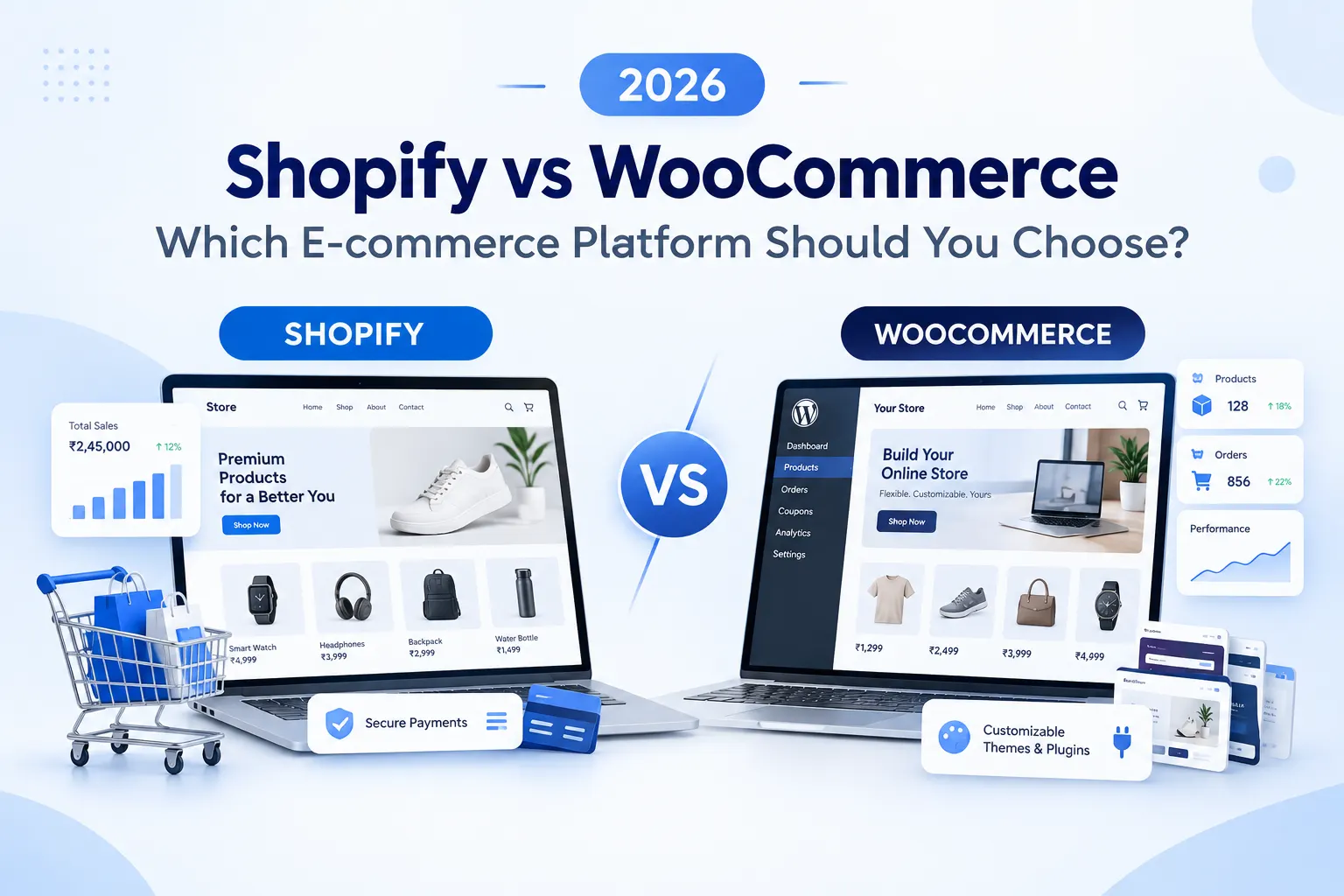
Shopify is a fully hosted e-commerce platform, meaning it handles hosting, security, and infrastructure for you in exchange for a monthly subscription. You are essentially renting a complete, ready-to-run online store.
Strengths:
- Extremely fast to launch a functional store can go live in days, not months.
- Hosting, security, PCI compliance, and uptime are all managed for you.
- A large app ecosystem covers almost any additional functionality you might need.
- Reliable performance even during high-traffic sales events, since Shopify’s infrastructure is built specifically for e-commerce load.
- Strong native payment gateway integration and checkout experience, which is one of the most conversion-critical parts of any store.
Limitations:
- Monthly subscription plus transaction fees (unless using Shopify Payments) add up as your store scales.
- Customisation beyond what themes and apps allow requires developer work within Shopify’s constraints.
- You do not own the platform you are building on rented infrastructure, and significant changes to Shopify’s policies or pricing are outside your control.
- Design flexibility is good but not unlimited compared to custom development.
Best for: Businesses that want to launch quickly, prioritise reliability and ease of management over deep customisation, and are comfortable with an ongoing subscription cost in exchange for not managing technical infrastructure themselves.
Option 2: WooCommerce The Flexible, Self-Hosted Choice
WooCommerce is a free plugin that turns a WordPress website into a full online store. Because it runs on WordPress, it inherits WordPress’s massive plugin ecosystem, content flexibility, and large talent pool of developers.
Strengths:
- No mandatory monthly platform fee you pay for hosting, which can be significantly cheaper at a smaller scale.
- Deep customisation is possible through the enormous WordPress and WooCommerce plugin ecosystem.
- Full ownership and control over your store’s code, data, and hosting environment.
- Excellent for businesses that want to combine a content-rich blog or resource section with their store, since WordPress handles content exceptionally well.
- A very large talent pool of developers and freelancers familiar with the platform.
Limitations:
- You are responsible for hosting, security, updates, and performance or need to pay someone who is.
- Performance and reliability depend heavily on your hosting choice and how well the site is maintained.
- Plugin conflicts and maintenance overhead are a real, ongoing consideration (see our guide on website maintenance for more on this).
- Scaling to very high traffic or complex catalogues requires more deliberate technical planning than with a fully managed platform.
Best for: Businesses that want full ownership and lower ongoing platform costs, already have (or plan to build) strong content around their products, and are willing to invest in proper hosting and maintenance.
Option 3: Custom Development Built for Your Exact Requirements
Custom development means building your store from the ground up using a framework rather than an existing CMS or platform, the same approach used for large-scale, complex, or highly specific e-commerce operations.
Strengths:
- No constraints from any platform’s architecture, any feature, integration, or workflow can be built exactly as needed.
- Can be architected specifically for your traffic patterns, catalogue complexity, and performance requirements.
- Complete ownership with no platform dependency or recurring subscription fees to a third-party e-commerce provider.
- The only realistic option for businesses with highly unusual requirements is complex pricing logic, deep ERP integrations, or unique marketplace functionality.
Limitations:
- Significantly higher upfront cost and longer development timeline than Shopify or WooCommerce.
- Ongoing developer dependency for changes, updates, and maintenance.
- Higher long-term maintenance investment, since you are responsible for everything a platform would otherwise provide out of the box.
Best for: Larger businesses with complex, specific requirements that no off-the-shelf platform can meet, and the budget to support custom development and ongoing technical maintenance.
Side-by-Side: What Actually Matters
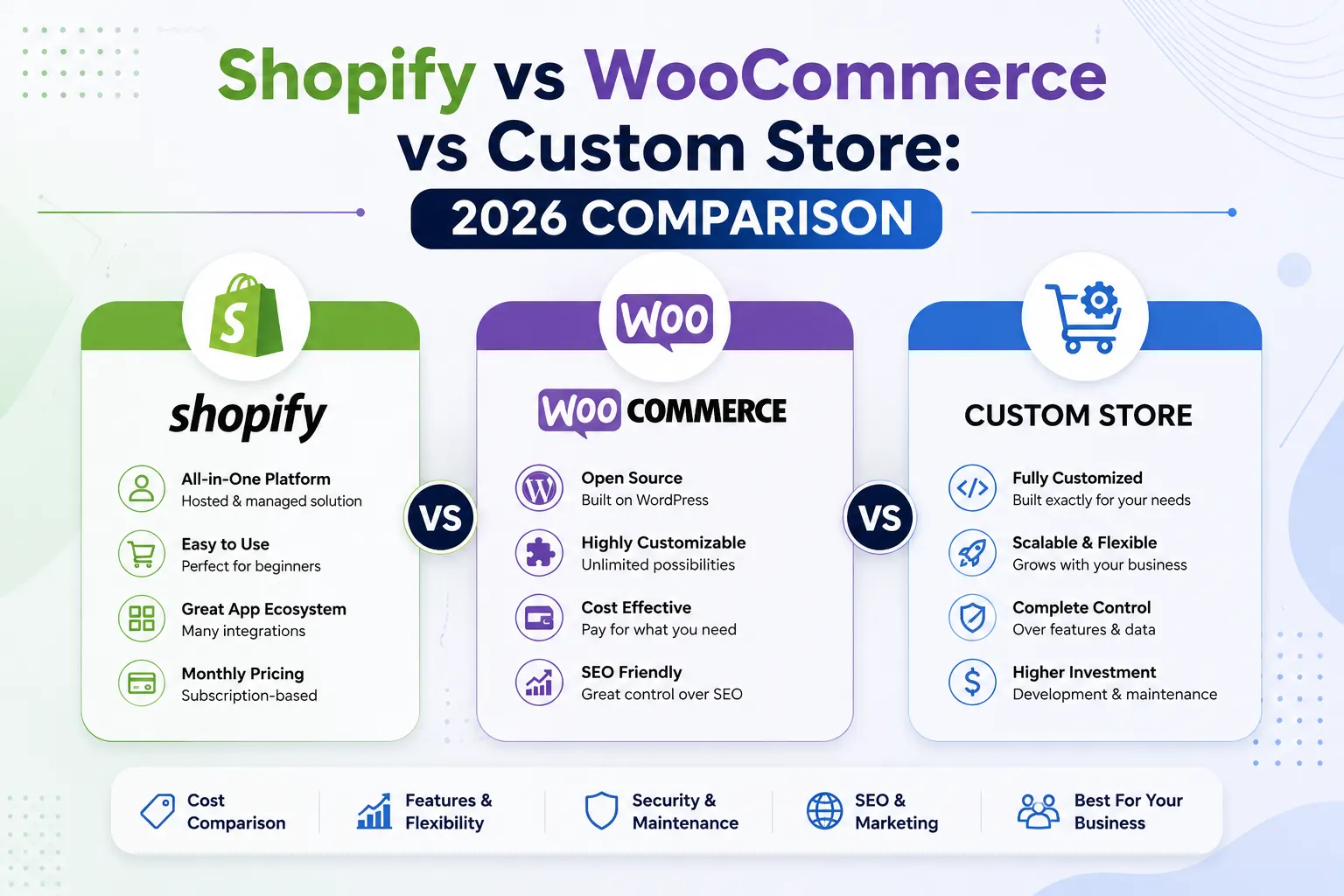
- Time to launch Shopify: Fast · WooCommerce: Fast to Medium · Custom: Slow
- Upfront cost Shopify: Low · WooCommerce: Low to Medium · Custom: High
- Ongoing cost Shopify: Subscription plus fees · WooCommerce: Hosting-based · Custom: Maintenance-based
- Customisation Shopify: Good, within platform limits · WooCommerce: High · Custom: Unlimited
- Technical maintenance Shopify: Handled for you · WooCommerce: Your responsibility · Custom: Your responsibility
- Ownership Shopify: Rented platform · WooCommerce: Full ownership · Custom: Full ownership
How to Actually Decide
Rather than starting with the platform, start with your business model:
- If you need to launch quickly, want predictable costs, and would rather focus on marketing and products than technical management Shopify is usually the right call.
- If you want full control, plan to invest heavily in content and SEO alongside your store, and are comfortable managing (or paying someone to manage) hosting and updates WooCommerce fits well.
- If your business has genuinely unique requirements that neither platform can accommodate, and you have the budget and timeline for it, custom development is worth the investment.
A Word on Switching Later
It is entirely possible to start on Shopify or WooCommerce and migrate to custom development later, once your business has proven its model and outgrown the platform’s constraints. What is much harder is guessing wrong at the very start and locking significant budgets into an approach that does not fit, which is why the decision deserves real thought rather than simply following whatever platform is trending.
The right platform is the one that matches your current stage, budget, and growth plans, not the one with the most hype.
Total Cost of Ownership Over 3 Years
Upfront cost tells only part of the story. It helps to think in terms of total cost of ownership over a realistic 3-year window, including platform fees, hosting, apps or plugins, and the developer time needed to maintain and grow the store:
- Shopify tends to have a moderate upfront cost but a steadily accumulating subscription and transaction fee cost over three years, partly offset by lower maintenance overhead since infrastructure is handled for you.
- WooCommerce often has the lowest 3-year cost for a moderately sized store, provided hosting and maintenance are managed properly, since there is no recurring platform fee.
- Custom development carries the highest upfront cost by a significant margin, and the 3-year total is highly dependent on how much ongoing developer support the platform requires; it only becomes cost-competitive at a scale where an off-the-shelf platform’s limitations would otherwise cost you in lost sales or functionality.
Modelling this out honestly, rather than comparing only launch quotes, often changes which platform looks like the better financial decision.
Migration Considerations: What If You Choose Wrong?
It is worth knowing upfront that migrating platforms later, while possible, is neither quick nor free. Moving from WooCommerce to Shopify (or the reverse) typically involves:
- Exporting and carefully re-mapping product data, images, and variants, which rarely transfers perfectly without manual cleanup.
- Rebuilding the store’s design within the new platform’s theme system rather than simply copying it over.
- Redirecting old URLs to new ones to preserve existing SEO rankings is a step that is frequently underestimated and, if done poorly, can cause a significant, sometimes permanent, drop in organic traffic.
- Re-testing every integration (payment gateways, shipping calculators, marketing tools) from scratch.
None of this makes switching impossible; many growing businesses do outgrow their first platform and move successfully. But it does make the initial choice worth getting right, since a migration a year or two in usually costs more in time and risk than the extra research needed to choose well at the start.
A Practical Starting Point
If you are still unsure after weighing all of this, a reasonable default for most small and mid-sized businesses launching their first serious online store is to start with Shopify for speed and reliability, or WooCommerce if you already have a WordPress site and want to keep content and commerce in one place. Reserve custom development for the point where your requirements have become genuinely specific enough that an off-the-shelf platform is holding you back not before.