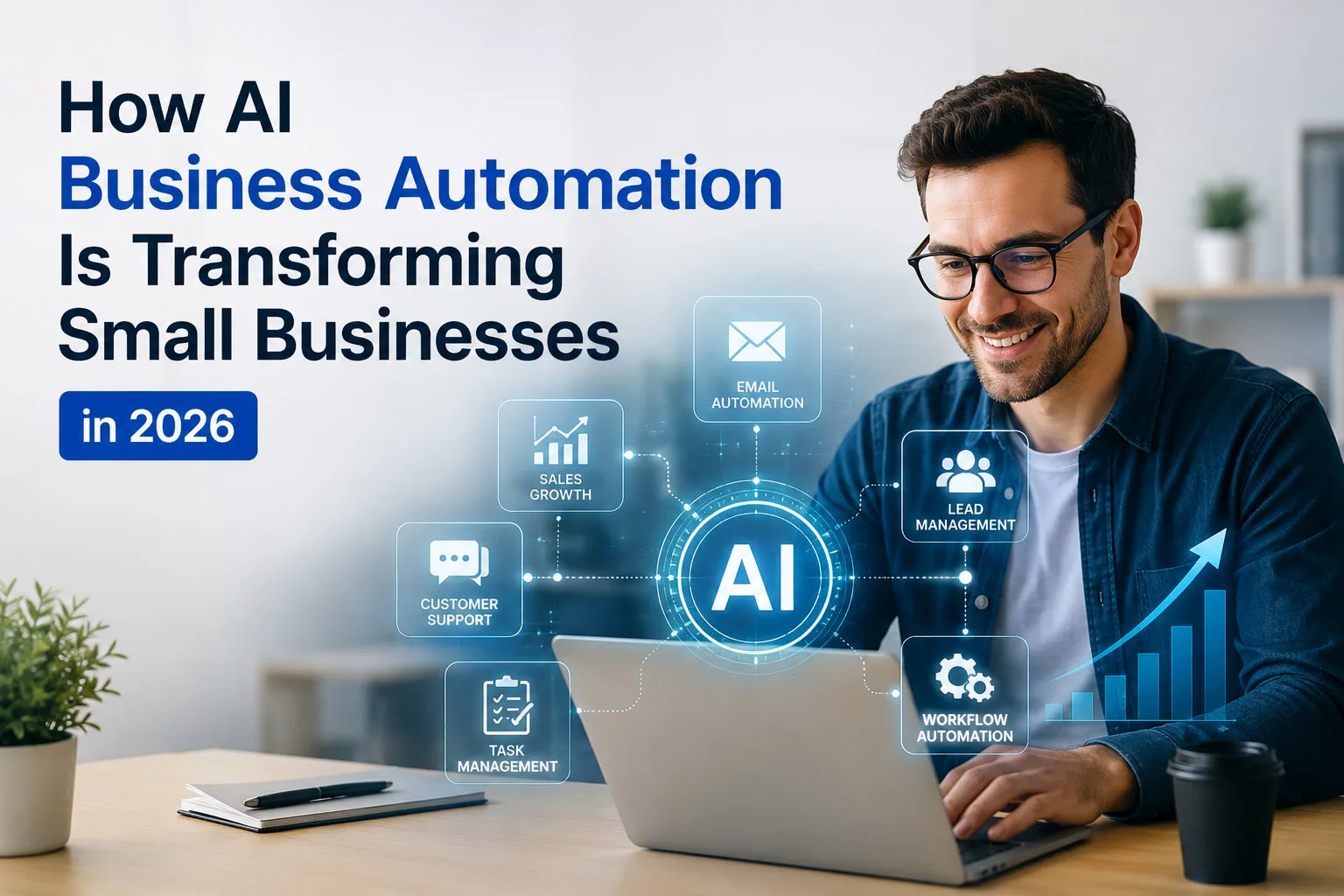
Artificial Intelligence (AI) is no longer a technology reserved for large enterprises with massive budgets. Today, AI-powered business automation has become an essential tool for small businesses looking to improve efficiency, reduce operational costs, and stay competitive in an increasingly digital marketplace.
From automating repetitive tasks to providing valuable business insights, AI enables organizations to work smarter instead of harder. Whether you operate a retail store, healthcare clinic, logistics company, financial service, or manufacturing business, AI automation can streamline workflows and allow your team to focus on high-value activities.
In this guide, we’ll explore how AI business automation is transforming small businesses, its key benefits, practical use cases, implementation strategies, and why now is the ideal time to embrace AI-driven solutions.
What Is AI Business Automation?
AI business automation refers to the use of artificial intelligence technologies to automate business processes that traditionally required human intervention.
Unlike traditional automation, which follows fixed rules, AI can:
- Learn from historical data
- Identify patterns
- Make predictions
- Process natural language
- Improve performance over time
- Support better decision-making
Modern AI solutions can automate tasks across departments, including sales, customer service, HR, finance, operations, marketing, and inventory management.
For small businesses, this means achieving enterprise-level efficiency without hiring large teams
Why Small Businesses Should Invest in AI Automation
Many business owners believe AI is expensive or too complex. In reality, cloud-based AI solutions have made advanced automation affordable and scalable for businesses of all sizes.
Some key advantages include:
Increased Productivity
Employees often spend significant time on repetitive administrative tasks such as entering data, sending emails, scheduling appointments, and generating reports.
AI automates these activities, allowing employees to focus on customer relationships, innovation, and strategic growth.
Lower Operating Costs
Automation reduces manual work, minimizes errors, and decreases operational expenses.
Businesses can often complete more work with existing staff instead of expanding teams, improving overall profitability.
Better Customer Experience
Customers expect quick responses and personalized experiences.
AI-powered chatbots, automated support systems, and recommendation engines enable businesses to provide 24/7 assistance while maintaining consistent service quality.
Improved Decision Making
AI analyzes large volumes of business data within seconds.
Instead of relying on assumptions, business owners receive actionable insights regarding:
- Sales trends
- Customer behavior
- Marketing performance
- Inventory levels
- Revenue forecasting
These insights support smarter business decisions.
10 Real-World AI Business Automation Use Cases
1. Customer Support Automation
AI chatbots can answer frequently asked questions, resolve basic issues, collect customer information, and transfer complex inquiries to human agents.
Benefits include:
- Faster response times
- Reduced support costs
- Higher customer satisfaction
- 24/7 availability
2. Sales Lead Qualification
AI evaluates incoming leads based on behavior, demographics, engagement, and previous interactions.
Sales teams can prioritize high-quality prospects instead of manually reviewing every inquiry.
3. Marketing Automation
AI helps businesses:
- Generate personalized email campaigns
- Recommend content
- Schedule social media posts
- Optimize advertising campaigns
- Improve conversion rates
Marketing becomes more efficient while reducing manual effort.
4. Invoice Processing
Finance teams spend considerable time processing invoices.
AI can:
- Extract invoice data
- Match purchase orders
- Verify information
- Detect duplicate invoices
- Reduce payment errors
This significantly speeds up financial operations.
5. Inventory Management
AI predicts product demand using historical sales, seasonal trends, and customer purchasing patterns.
Businesses can:
- Prevent stock shortages
- Reduce excess inventory
- Improve warehouse efficiency
- Lower storage costs
6. HR Recruitment
Hiring can be time-consuming.
AI helps HR departments by:
- Screening resumes
- Matching candidates
- Scheduling interviews
- Reducing administrative workload
Recruiters spend more time evaluating top candidates.
7. Predictive Maintenance
Manufacturing businesses use AI to monitor equipment performance.
Instead of waiting for machinery to fail, AI predicts maintenance needs before breakdowns occur, reducing downtime and repair costs.
8. Document Processing
AI can automatically process:
- Contracts
- Purchase orders
- Insurance claims
- Medical records
- Business forms
This reduces paperwork and improves operational speed.
9. Business Analytics
AI dashboards combine information from multiple systems into a single interface.
Business owners can monitor:
- Revenue
- Expenses
- Customer acquisition
- Employee performance
- Operational efficiency
Real-time insights support faster decision-making.
10. Personalized Customer Recommendations
AI analyzes customer behavior to recommend products or services that match individual preferences.
This increases:
- Customer engagement
- Average order value
- Repeat purchases
- Customer loyalty
Industries Benefiting from AI Automation
AI automation is delivering measurable value across many industries.
Healthcare
- Appointment scheduling
- Patient management
- Medical documentation
- Administrative automation
Retail
- Inventory forecasting
- Product recommendations
- Customer service
- Sales analytics
Manufacturing
- Production monitoring
- Quality control
- Predictive maintenance
- Supply chain optimization
Logistics
- Route optimization
- Shipment tracking
- Fleet management
- Warehouse automation
Financial Services
- Fraud detection
- Loan processing
- Customer verification
- Risk analysis
Challenges Businesses Should Consider
While AI offers significant advantages, successful implementation requires careful planning.
Common challenges include:
- Poor data quality
- Employee resistance to change
- Integration with existing software
- Security and compliance requirements
- Choosing the right technology partner
Working with an experienced software development company helps businesses overcome these challenges while ensuring a smooth implementation.
How to Successfully Implement AI Automation
Businesses should approach AI adoption strategically.
Step 1
Identify repetitive manual processes.
Step 2
Define measurable business goals.
Step 3
Select AI solutions aligned with your business needs.
Step 4
Integrate AI with existing systems.
Step 5
Train employees.
Step 6
Monitor performance and continuously optimize workflows.
Starting with one process before expanding automation across the organization often produces the best results.
Why Choose Codeska?
At Codeska, we help businesses leverage AI-powered solutions to improve efficiency, automate operations, and accelerate digital transformation.
Our expertise includes:
- Custom AI solutions
- Business process automation
- Custom software development
- Web application development
- Mobile app development
- CRM and ERP solutions
- API integrations
- Cloud-based business applications
We work closely with businesses to understand their goals and deliver scalable technology solutions that support long-term growth.
Frequently Asked Questions
Is AI business automation expensive?
Not necessarily. Many AI solutions are scalable, allowing small businesses to start with affordable implementations and expand as they grow.
Can AI replace employees?
AI is designed to automate repetitive tasks, enabling employees to focus on strategic, creative, and customer-focused work rather than replacing them entirely.
How long does AI implementation take?
Implementation timelines vary depending on project complexity. Simple automations can be completed within weeks, while enterprise solutions may require several months.
Which business processes should be automated first?
Businesses often begin with customer support, sales, invoicing, marketing automation, or reporting because these areas typically deliver quick returns.